


Lower Austria: Complete Guide to Geography, Politics & Culture (2026)
Lower Austria is the country’s largest federal state by area and the historic heartland of Austria, home to the Wachau Valley, hundreds of castles and abbeys, and the country’s leading wine region. This guide covers Lower Austria’s geography, how to get there, government, economy, cities, things to do, food and wine, festivals, history, demographics, and culture.
Lower Austria Geography and Location
Lower Austria sits in the northeast of the country, completely encircling Vienna, and bordered by the Czech Republic to the north, Slovakia to the east, Burgenland and Styria to the south, and Upper Austria to the west. At 19,178 km², it’s the largest of Austria’s nine states by area. The Danube River cuts through the state west to east, dividing it into the Waldviertel and Weinviertel regions to the north and the Mostviertel and Industrieviertel to the south. The Wachau Valley, a UNESCO World Heritage Site along the Danube, is the state’s best-known landscape, alongside the Vienna Woods (Wienerwald) to the south.
How to Get to Lower Austria from Vienna
Lower Austria’s biggest advantage is its proximity to the capital, several of its major towns are effectively Vienna commuter destinations. By train, ÖBB regional and REX services connect Vienna Hauptbahnhof to Wiener Neustadt in around 30 minutes, and to St. Pölten in around 25 minutes. Krems an der Donau, gateway to the Wachau Valley, is reachable in about an hour. By car, the A1, A2, and A21 motorways connect Vienna to most of the state within 30 to 90 minutes depending on destination. Danube river cruises and the Wachau bike path are also popular ways to reach and explore the region in summer.
Best Time to Visit Lower Austria
Lower Austria has a varied continental climate shaped by its geography, drier and warmer in the Danube basin, cooler and more alpine toward the south. Spring through Wachau’s apricot blossom season (April) and the wine harvest in September and October are especially popular. Summer brings music festivals and open-air events across the state, while the Danube Valley’s vineyards and castle towns are photogenic in every season.
Lower Austria Weather and Climate
Lower Austria has a continental climate that varies notably across the state. The Danube basin and eastern lowlands see warm, dry summers and cold winters typical of a Pannonian-influenced climate, while the Waldviertel in the north and the alpine south are cooler and wetter year-round. Annual rainfall ranges from under 500mm in the dry northeast to considerably higher totals in the south, one of the widest precipitation ranges of any Austrian state.
Lower Austria Politics and Government
Lower Austria is one of Austria’s nine federal states, with St. Pölten as its capital since 1986 (before that, the state was administered from Vienna). The state is governed by the Lower Austrian State Government, led by Governor (Landeshauptfrau) Johanna Mikl-Leitner of the Austrian People’s Party (ÖVP), in office since 2017. Lower Austria holds 12 of the 62 seats in Austria’s Federal Council (Bundesrat), the most of any state.
Lower Austria Economy
Lower Austria has a diversified economy anchored by agriculture and wine production, it’s Austria’s largest wine-growing region by volume, alongside manufacturing, logistics, and a growing services sector benefiting from proximity to Vienna. Many residents commute into the capital for work, and the state hosts significant industrial operations in its Industrieviertel region south of Vienna.
Lower Austria Cities and Districts
Lower Austria’s main cities are St. Pölten (the capital), Wiener Neustadt, Krems an der Donau, and Amstetten. The state is organized into 21 districts and statutory cities:
| District Type | Names |
|---|---|
| Districts (20) | Amstetten, Baden, Bruck an der Leitha, Gänserndorf, Gmünd, Hollabrunn, Horn, Korneuburg, Krems-Land, Lilienfeld, Melk, Mistelbach, Mödling, Neunkirchen, Sankt Pölten-Land, Scheibbs, Tulln, Waidhofen an der Thaya, Wiener Neustadt-Land, Zwettl |
| Statutory Cities (4) | Krems an der Donau, St. Pölten, Waidhofen an der Ybbs, Wiener Neustadt |
Top Things to Do in Lower Austria
- Cruise or cycle through the Wachau Valley, past vineyards and towns like Dürnstein and Spitz
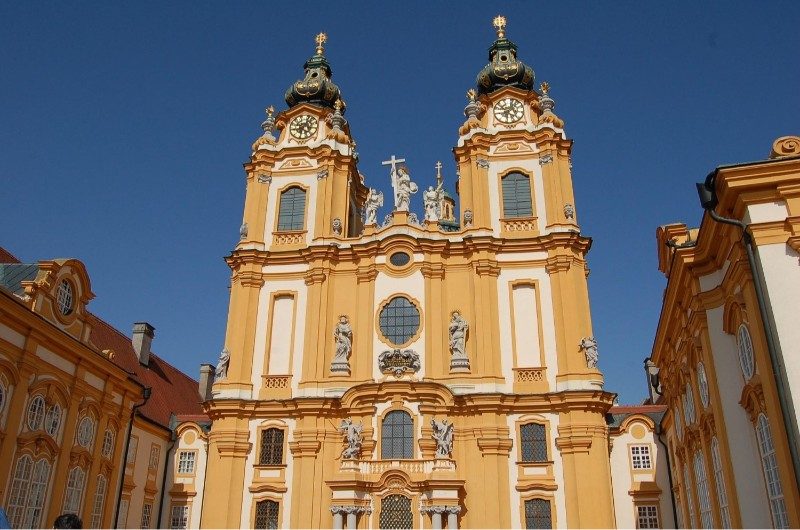
- Tour Melk Abbey, a Baroque monastery perched above the Danube
- Explore the Kunsthistorisches-affiliated museums and cultural district in St. Pölten
- Visit Klosterneuburg Abbey, founded in 1114, just outside Vienna
- Walk the Vienna Woods (Wienerwald) for hiking and thermal spa towns like Baden
Lower Austria Wine Regions
Lower Austria’s wine production is concentrated in four main regions: the Wachau, prized for Grüner Veltliner and Riesling grown on Danube-facing terraces; the Weinviertel, Austria’s largest wine region by area, known for crisp whites and traditional Kellergassen (cellar lanes); Carnuntum, southeast of Vienna, known increasingly for red wines like Zweigelt; and the Thermenregion, south of Vienna near Baden, known for both wine and its thermal spa towns.
Lower Austria Food and Wine
Lower Austria is Austria’s largest wine-producing state, known especially for Grüner Veltliner and Riesling grown along the terraced slopes of the Wachau Valley. The state’s inn and Heuriger (wine tavern) culture runs deep, particularly in the Weinviertel region. On the food side, regional specialties include Marillenknödel (apricot dumplings, tied to the Wachau’s apricot orchards), Waldviertel poppy seed dishes, and hearty game dishes from the state’s forested regions.
Festivals and Events in Lower Austria
- Grafenegg Festival, a major classical music festival held at Grafenegg Castle each summer
- Danube Festival (Donaufestival), held in Krems
- Weinherbst (Wine Autumn), a state-wide celebration of the harvest season across the wine regions
Lower Austria History
Lower Austria is considered the historic cradle of Austria, home to the medieval Babenberger and Kuenringer dynasties whose fortified estates shaped the region. Over 550 castles and fortresses once stood across the state, many still standing today, including Dürnstein, where Richard the Lionheart was famously held captive. Vienna served as the state’s administrative capital until 1986, when St. Pölten, then a smaller provincial town, was chosen by public referendum, making it the youngest state capital in Europe.
Lower Austria Demographics
Lower Austria’s population is approximately 1,730,094 as of early 2026, making it Austria’s second most populous state after Vienna. German is the official and dominant language throughout the state, covered in more detail in our guide to what language is spoken in Austria.
Lower Austria Culture
Lower Austria’s cultural identity is shaped by its castles, abbeys, and wine tradition, alongside a modern cultural push centered on St. Pölten’s Festspielhaus and cultural district. The state has one of the highest concentrations of museums in Austria, with roughly 600 spread across its towns and villages. For more on Lower Austria’s place within the wider Republic of Austria, see our complete country guide and our full breakdown of Austria’s states, districts, and cities.
Living in Lower Austria
Lower Austria is one of the most popular relocation choices for people working in Vienna but wanting lower housing costs and a quieter setting, particularly in commuter towns like Baden, Mödling, and Tulln, all within easy rail reach of the capital. The state’s mix of small-town living, strong infrastructure, and proximity to Vienna’s job market makes it a common choice for families and international residents alike.
FAQ: Lower Austria
What is Lower Austria known for?
The Wachau Valley, Melk Abbey, its wine regions, and hundreds of castles and monasteries across the state.
Why is it called Lower Austria if it’s north of Vienna?
The name refers to its lower position along the Danube’s flow (west to east), not its geographic north-south position.
What is the capital of Lower Austria?
St. Pölten, since 1986. Before that, the state was governed from Vienna.
Who is the governor of Lower Austria?
Johanna Mikl-Leitner (ÖVP) has served as governor since 2017.
What is the population of Lower Austria?
Approximately 1,730,094 as of early 2026, the second most populous state after Vienna.



)