


Retirement in Austria: Pension Guide, Age & Rules 2026
Every payslip in Austria already shows a pension contribution line, something we touched on briefly in our working in Austria guide and tax guide. This guide to retirement in Austria goes deeper: how the state pension actually works, what it takes to qualify, and what changes for people who’ve only worked part of their career inside Austria.
How Austria’s Pension System Works
Austria runs a pay-as-you-go (PAYG) state pension: today’s workers fund today’s retirees through ongoing contributions, rather than each person saving into a personal investment pot. Every insured month of a person’s working life is recorded in an individual Pensionskonto (pension account), which the insured person can check online at any time, and which forms the basis for calculating their eventual benefit.
Retirement Age in Austria: 2026 Rules
The standard retirement age is 65 for men. For women, the age is still rising in half-year steps under a 1992 constitutional law, moving from 60 up to 65 between 2024 and 2033:
| Date of Birth | Standard Retirement Age |
|---|---|
| 1 Jan – 30 Jun 1964 | 60 years 6 months |
| 1 Jul – 31 Dec 1964 | 61 years |
| 1 Jan – 30 Jun 1965 | 61 years 6 months |
| 1 Jul – 31 Dec 1965 | 62 years |
| 1 Jan – 30 Jun 1966 | 62 years 6 months |
| 1 Jul – 31 Dec 1966 | 63 years |
| 1 Jan – 30 Jun 1967 | 63 years 6 months |
| 1 Jul – 31 Dec 1967 | 64 years |
| 1 Jan – 30 Jun 1968 | 64 years 6 months |
| After 30 Jun 1968 | 65 years |
Deferring a pension past standard retirement age also carries a reward: each year of deferral adds a 5.1 percent bonus, up to a maximum of 15.3 percent for three years deferred.
Qualifying for a Pension: The 180-Month Minimum
To receive any Austrian state pension at all, an applicant needs at least 180 insurance months, the equivalent of 15 years of contributions. Falling short of that threshold on Austrian contributions alone doesn’t necessarily mean missing out entirely, since time worked in other countries can often be combined, covered in the totalization section below.
The 45-65-80 Rule, and What an Austrian Pension Actually Pays
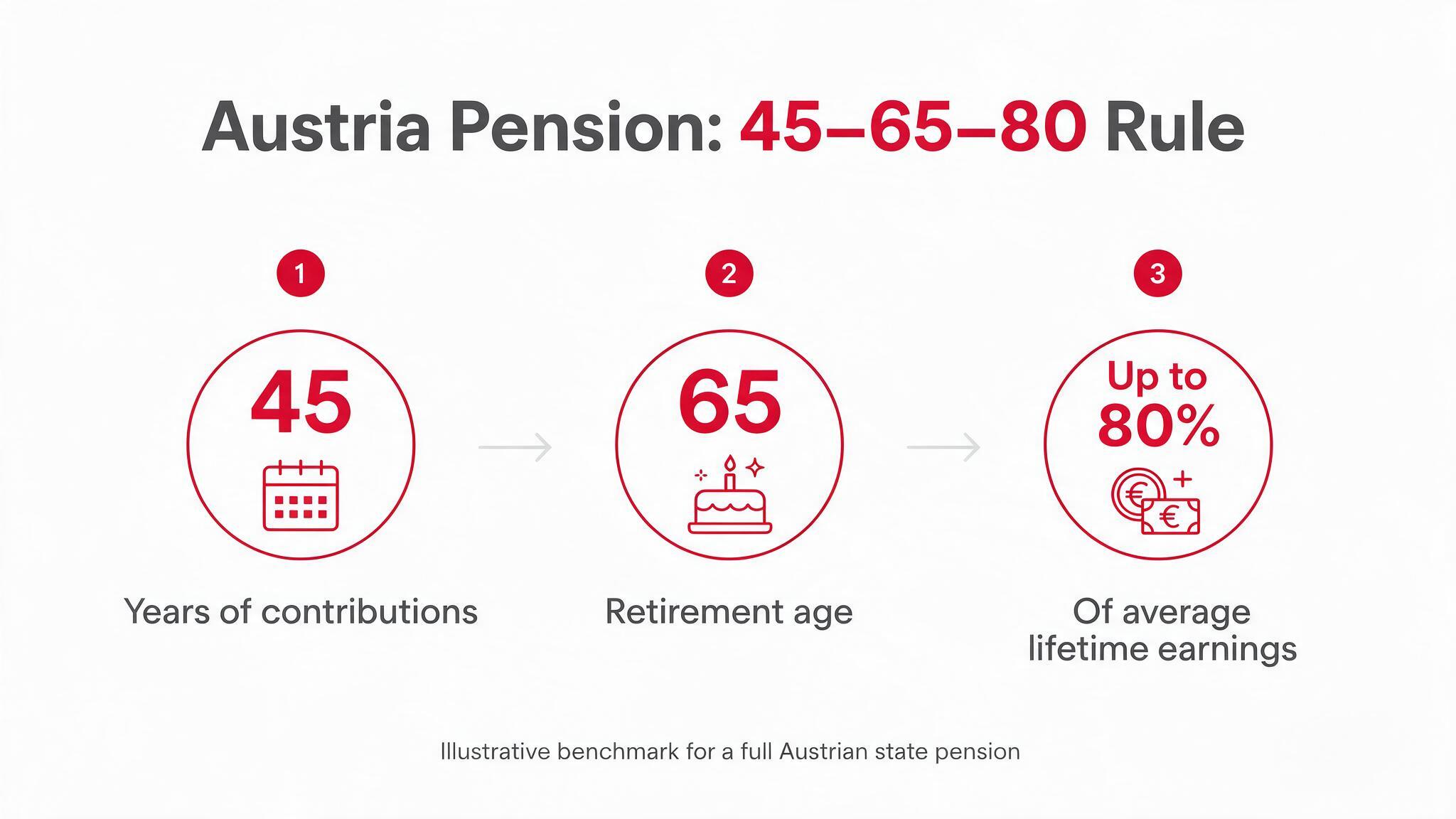
Austria’s benefit calculation is often summarized as the 45-65-80 rule: someone who contributes for 45 years and retires at 65 can receive up to 80 percent of their average lifetime earnings as their pension, subject to a contribution ceiling. In practice, most retirees receive less than that maximum. Based on municipal statistics drawn from annual pension insurance data, the average gross monthly pension in Austria runs to roughly €2,535 for men and €1,527 for women, a gap driven mainly by differences in contribution years and lifetime earnings rather than the formula itself. Newly granted pensions run somewhat higher on both sides, around €2,762 for men and €1,826 for women, reflecting updated benchmark values.
Pension Contributions
Pension insurance is funded through payroll contributions split between employer and employee: 10.25 percent of gross salary from the employee, and 12.55 percent from the employer, sitting within the broader social security contributions covered in our working in Austria guide. As with other social insurance contributions, pension contributions stop once monthly income passes the Höchstbeitragsgrundlage (maximum contribution base, €6,930/month in 2026), which also caps how large a future pension payout can eventually be, regardless of how high someone’s actual salary runs.
The 2026 Pension Increase
Pensions were adjusted for inflation from January 1, 2026. Pensions up to €2,500 a month received a full 2.7 percent increase, matching that portion of the cost of living. Pensions above that threshold received a flat increase of €67.50 a month instead of the full percentage rise, a policy choice the government has described as more socially balanced, since around 71 percent of pensioners fall under the €2,500 threshold and received the full adjustment.
Early Retirement in Austria
Early retirement is possible from age 62, though taking a pension before the standard retirement age comes with a permanent reduction applied for each year taken early. Anyone considering this route should weigh the lifetime reduction carefully against the value of retiring sooner, since the discount applies for the rest of the pension’s duration, not just the early years.
For Foreign Workers: Totalization Agreements
This is the detail most newcomers miss. Austria has totalization agreements with a number of countries, including the United States, alongside EU-wide coordination rules for EU/EEA citizens, that allow insurance periods from different countries to be combined toward the 180-month qualifying minimum. In practice, this means years spent working in your home country, or another country with an agreement in place, can count toward Austrian eligibility, and vice versa, rather than each country’s pension system treating your career as if it started fresh. To have periods combined, an applicant generally needs at least 12 months of Austrian coverage if applying inside Austria, or a minimum coverage period under the partner country’s system if applying from abroad. Given how country-specific the rules are, checking the exact agreement that applies to your nationality is essential before assuming any particular outcome.
Occupational and Private Pensions
Beyond the state system, many employers offer supplementary coverage through Pensionskassen, occupational pension funds set up as legally separate entities from the sponsoring company. These aren’t mandatory, but they’re common at larger employers and provide an additional layer on top of the state pension rather than a replacement for it.
Long-Term Care: A Related but Separate Benefit
Retirement pensions and long-term care support are handled as two distinct systems in Austria. The Pflegegeld (care allowance) covers ongoing care needs rather than retirement income itself, and its rates were increased again for 2026; our dedicated Pflegegeld guide covers current payment levels and eligibility in full.
Can I retire in Austria if I only worked here for a few years?
Possibly, if your home country has a totalization agreement with Austria or you’re covered under EU coordination rules, since periods from both countries can often be combined toward the 180-month minimum.
How much is the average pension in Austria?
Based on annual pension insurance data, the average gross monthly pension runs to roughly €2,535 for men and €1,527 for women, though individual amounts depend heavily on total contribution years and lifetime earnings.
When will the retirement age be the same for men and women?
For anyone born after 30 June 1968, the standard retirement age is already 65, matching men. The transition completes fully by 2033.
Do self-employed people pay into the same pension system?
Self-employed individuals contribute through a related but distinct scheme with its own rates, rather than the standard employee ASVG contributions described here.
This guide to retirement in Austria covers the core rules as they stand for 2026, but figures like contribution ceilings and the annual pension adjustment change yearly. For definitive, current figures, always verify against Austria’s Pension Insurance Agency (PVA), since contribution ceilings, retirement-age schedules, and benefit calculations are adjusted regularly.