


Austria Tax Guide 2026: Income Tax, Rates & What Foreigners Need to Know
This Austria tax guide 2026 breaks down what you actually owe once you’re living and working here. Holding a visa, an Austrian residence permit, or citizenship settles where you can live, not what you owe the Austrian tax office. That’s a separate legal test entirely, and understanding it before your first Austrian payslip lands saves a lot of confusion when the numbers don’t match what you expected.
Are You a Tax Resident?
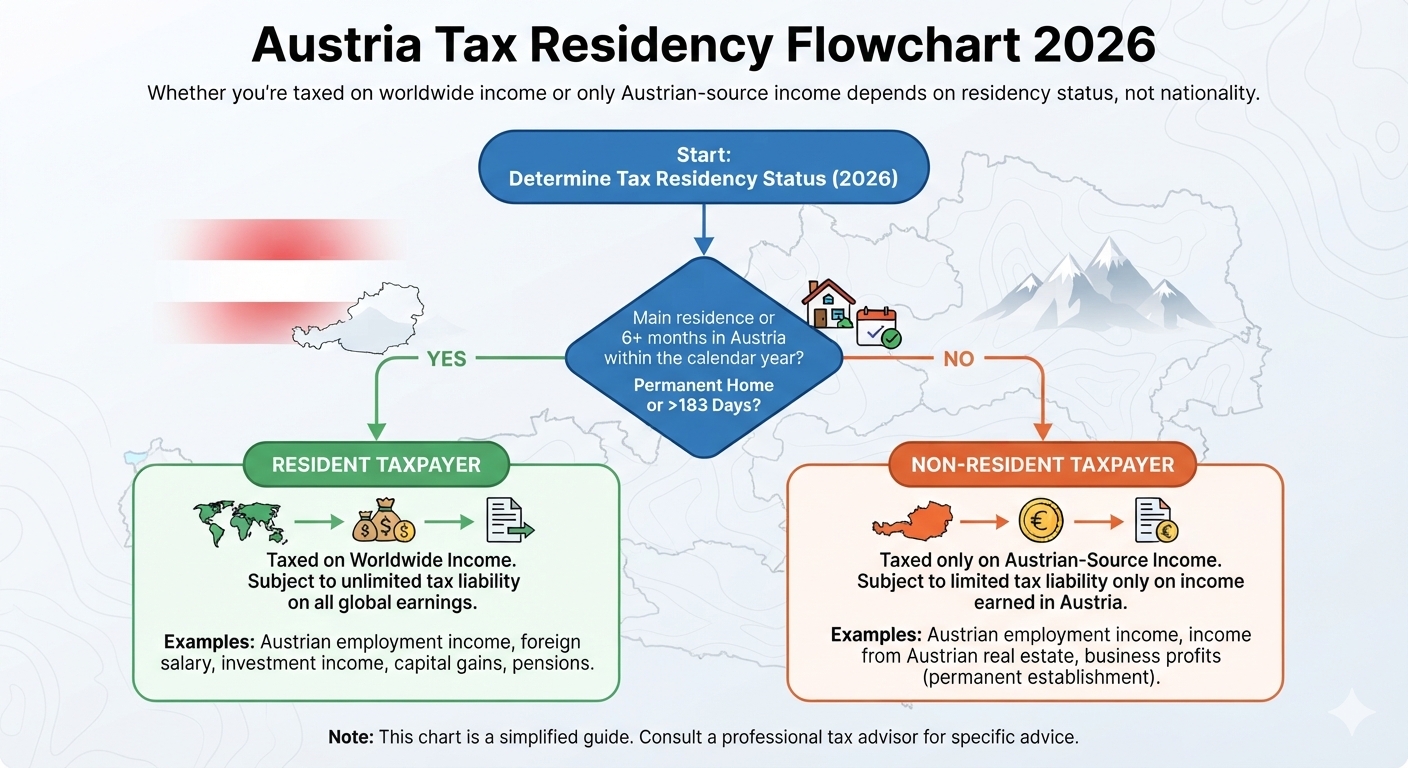
Austria taxes people differently depending on residency status, not nationality or permit type. You count as a tax resident, liable on your worldwide income, if either applies: your primary residence (Wohnsitz) is in Austria, or your habitual abode (gewöhnlicher Aufenthalt) is in Austria, generally meaning more than six months physically present in a calendar year. Non-residents are taxed only on Austrian-source income, such as local employment, business profits, or rental income from Austrian property.
This distinction matters most for people newly arrived on a residence permit: moving your main residence to Austria typically triggers full tax residency well before any citizenship question ever comes up.
Income Tax Brackets for 2026
Austria runs a progressive system (Einkommensteuer) with seven bands, adjusted upward each year to offset bracket creep:
| Taxable Income | Rate |
|---|---|
| Up to €13,539 | 0% |
| €13,539 – €21,992 | 20% |
| €21,992 – €36,458 | 30% |
| €36,458 – €70,365 | 40% |
| €70,365 – €104,859 | 48% |
| €104,859 – €1,000,000 | 50% |
| Above €1,000,000 | 55% |
These thresholds rose by roughly 1.73 percent for 2026 as part of Austria’s automatic inflation indexing, a mechanism made permanent when the country abolished cold progression in an earlier reform. Before that change, bracket thresholds stayed frozen while wages rose, quietly pushing more income into higher bands every year.
The 13th and 14th Salary: Austria’s Hidden Tax Break
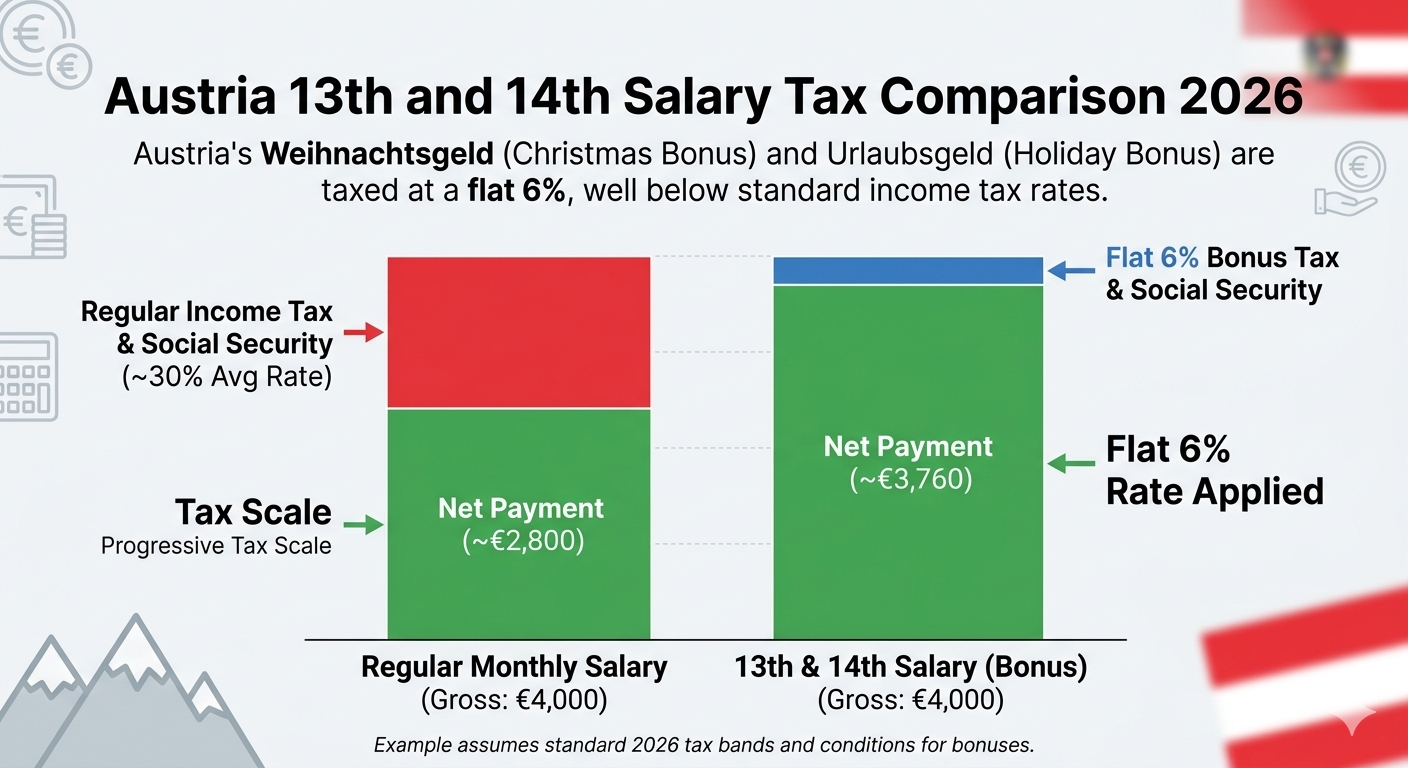
Most Austrian employees receive two extra monthly payments a year, Weihnachtsgeld (Christmas bonus) and Urlaubsgeld (holiday bonus), effectively 14 paychecks annually instead of 12. Critically, these special payments are taxed at a flat 6 percent rather than the regular progressive rates, after a small tax-free allowance. For a mid-range earner, this quietly saves several thousand euros a year compared to a country that taxes every payment identically, and it’s one of the biggest reasons Austria’s effective tax rate ends up lower than its headline brackets suggest.
Social Security Contributions
Alongside income tax, employees pay social security contributions covering pension, health, and unemployment insurance, running to roughly 18 percent of gross salary, deducted automatically by the employer before wage tax is calculated. Contributions stop once monthly gross pay passes a set ceiling, though wage tax continues applying above that point.
Pension contributions specifically feed into Austria’s retirement system; see our retirement in Austria guide for how those contributions translate into eventual pension benefits.
Capital Gains and Investment Income
Dividends, interest, and securities gains are taxed under a flat withholding regime called KESt (Kapitalertragsteuer) at 27.5 percent, regardless of income bracket or holding period, and is generally withheld automatically by Austrian banks and brokers. Cryptocurrency gains have been taxed under this same flat rate since 2022, rather than as ordinary income.
Church Tax
Registered members of recognized religious communities, most commonly Catholic or Protestant churches, pay a church tax (Kirchenbeitrag) of roughly 1.1 percent of taxable income. It’s separate from income tax and only applies to registered members; formally leaving the relevant church body stops the obligation going forward.
Family Tax Credits
Austria offsets its high headline rates with meaningful family relief. The Familienbonus Plus provides a tax credit per child, alongside the Kinderabsetzbetrag child credit and an additional Alleinerzieherabsetzbetrag allowance for single parents. Together these can meaningfully reduce the effective tax burden for working parents, and they apply regardless of nationality once a family is Austrian tax resident.
Filing a Tax Return
Employees whose wage tax is fully withheld by their employer generally aren’t required to file an annual return, though filing voluntarily can trigger a refund if deductible expenses weren’t already accounted for. Self-employed people and anyone with additional untaxed income must file annually. The standard deadline is April 30 for paper filings or June 30 for electronic filing through FinanzOnline, Austria’s official online tax portal, with further extensions often available when filing through a registered tax advisor.
For freelancers, founders, and small business owners specifically, the rules diverge further around VAT registration, provisional payments, and deductible expenses; our tax guide for foreign entrepreneurs covers that ground in full.
Austria Tax Guide 2026: Recent Reforms Worth Tracking
Austria’s tax settings have shifted meaningfully in the past two years: the abolition of cold progression locked in annual bracket indexing, while the government’s broader austerity package and its tax impact has adjusted the fiscal picture further for 2026. Anyone budgeting around Austrian take-home pay should check both pieces for what’s changed most recently, since further adjustments tend to land with each new budget cycle.
Frequently Asked Questions
Do I pay Austrian tax on income earned outside Austria?
Only if you’re a full tax resident, meaning your main residence or habitual abode is in Austria. Non-residents are taxed solely on Austrian-source income.
Is the 55% top rate common?
No. It only applies to taxable income above €1,000,000 a year; the vast majority of earners fall well within the 20-40% bands.
Does my residence permit affect my tax status?
Not directly. Tax residency is a separate legal test based on where you actually live and for how long, not which permit or visa you hold.
What happens if I miss the filing deadline?
Late filing can trigger penalties, though extensions are often available, particularly when filing through a registered tax advisor rather than independently.
For definitive, current figures, always verify against Austria’s Federal Ministry of Finance, since brackets, allowances, and thresholds adjust annually.