


Austria Visa Guide 2026: Types, Fees, and How to Apply
Every year, tens of thousands of people move to Austria to study, work, join family, or simply enjoy the low crime rate and central European location. Almost none of them start with the same question twice: which visa do I actually need? This guide breaks down every entry category for 2026, what each one costs, how long each one takes, and where the visa system hands off to a residence permit.
Do You Need a Visa at All?
Citizens of the EU, EEA and Switzerland can enter and live in Austria without a visa under freedom of movement rules. Nationals of many other countries, including the US, UK, Canada, Australia, Japan and most of Latin America, can enter visa-free for short tourism or business trips of up to 90 days in any 180-day period. Everyone else needs to apply for a visa before travel.
The confusion usually starts here: even visa-exempt travelers who plan to stay longer than 90 days, work, study, or join family in Austria still need to apply for the right permit before that 90-day window runs out.

The Three Categories: Type A, Type C, Type D
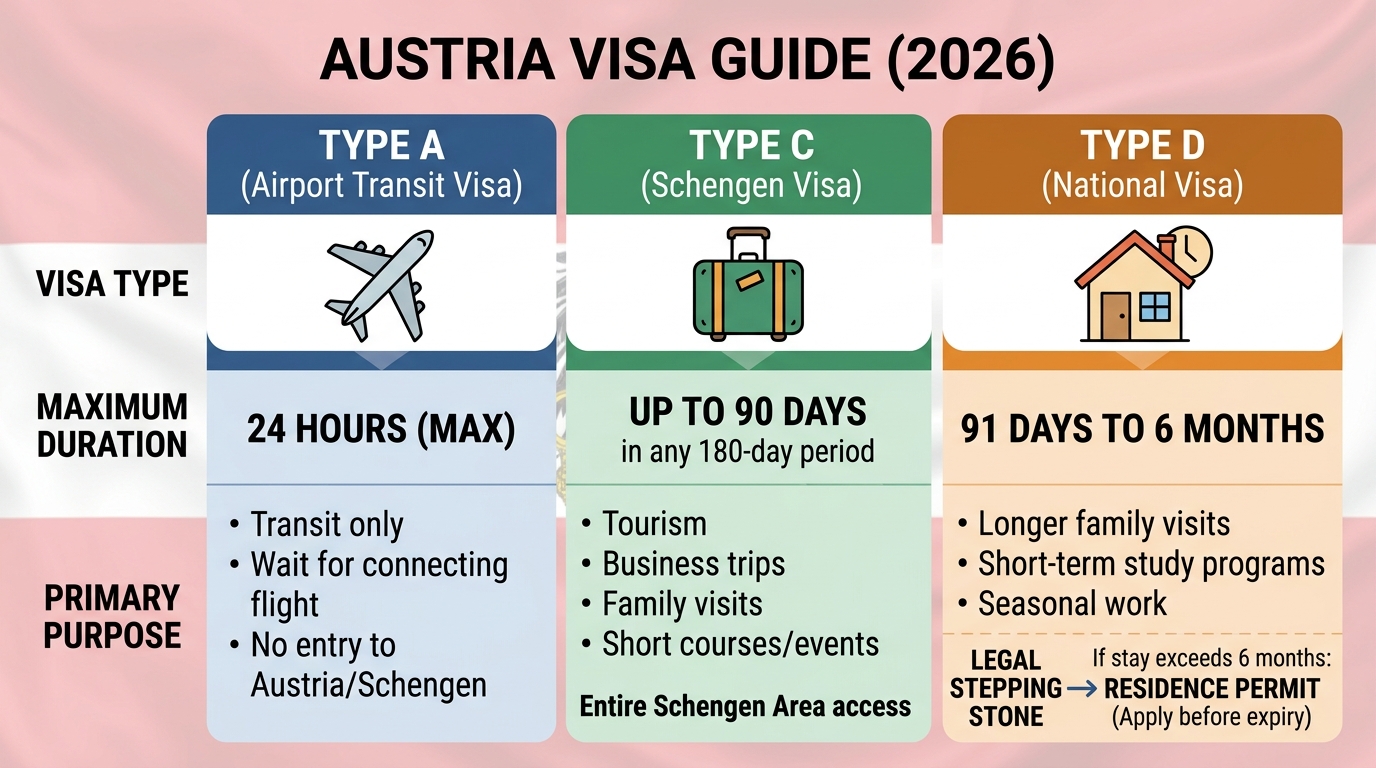
Austria, like every Schengen state, issues three visa types:
Type A (Airport Transit Visa) covers nationals of a small list of countries who need to change planes at an Austrian airport without formally entering the country. It cannot be extended and is rarely relevant outside international connections.
Type C (Schengen Visa) is the standard short-stay visa. It covers tourism, business trips, family visits, and short courses for up to 90 days within any 180-day period, and it grants access to the entire Schengen area, not just Austria. This is what most visa-requiring travelers apply for.
Type D (National Visa) is Austria-specific and covers stays of 91 days up to six months, for purposes like longer family visits, seasonal work, or short study programs that don’t require a full residence permit. A Type D visa also lets the holder move freely through other Schengen countries for up to 90 days within its validity.
If your planned stay in Austria goes beyond six months, no visa covers that; you’ll need a residence permit instead, applied for through a different process entirely.
Documents You’ll Need
Regardless of visa type, Austrian consulates generally expect:
- A passport valid for at least three months beyond your planned departure, issued within the last 10 years, with at least two blank pages
- A completed application form
- A recent passport-style photo
- Proof of purpose of travel (invitation letter, enrollment confirmation, employment contract, etc.)
- Proof of sufficient funds to cover the stay
- Travel or health insurance meeting Schengen requirements (minimum coverage around €30,000)
- Proof of accommodation in Austria
Applicants who don’t meet the funds requirement independently can be sponsored by a relative, though sponsorship from a first-degree relative or someone already holding Austrian residency or citizenship tends to strengthen the application.
Fees and Processing Times for 2026
Visa fees are set at EU level for the Schengen visa and can shift with regulation changes. As of 2026, the standard adult Schengen (Type C) visa fee sits at €90, with a reduced rate of €45 for children aged 6 to 11 and no charge for children under 6. National (Type D) visa fees vary somewhat by consulate and purpose, generally landing between €75 and €120, so it’s worth confirming the exact figure with the consulate handling your application before you pay.
Applications can be submitted as early as six months before travel and no later than 15 days before, and processing typically takes 15 to 60 days depending on the applicant’s nationality and the consulate’s workload. Applying early, especially during summer and holiday peak seasons, avoids most delays.

What’s Changing in 2026: ETIAS and EES
Two system changes affect visa-exempt travelers specifically. The Entry/Exit System (EES) has begun replacing manual passport stamping with electronic logging of entries and exits for non-EU nationals at Schengen borders, which has already caused longer queues at some crossings during the rollout. Separately, the EU’s ETIAS travel authorization, a low-cost pre-travel screening for visa-exempt nationals such as UK and US citizens, is expected to become mandatory later in 2026. It isn’t a visa, but travelers who currently enter Austria visa-free will need to apply for it online before their trip once it takes effect.
Common Mistakes That Delay Applications
- Applying for a Schengen (Type C) visa when the actual length of stay requires a Type D or a residence permit
- Booking non-refundable flights before the visa is approved
- Submitting insurance documents that don’t meet the minimum coverage requirement
- Applying at the wrong consulate; the correct one is determined by the country where you’ll spend most of your trip, or your first point of entry if the trip is split across multiple countries
- Underestimating processing time during peak travel seasons
Visa or Residence Permit: Which One Applies to You?
The visa system stops covering you the moment your stay exceeds six months. That’s a distinct legal process in Austria, requiring an Aufenthaltsbewilligung or Aufenthaltstitel residence permit with its own income, health insurance, and housing requirements. Some categories, like people planning to live in Austria without local employment, face particularly strict financial thresholds worth reviewing separately, as do foreign employers navigating Austria’s labor rules for staff relocating on longer-term visas or permits.
For those planning to stay long enough to eventually naturalize, our Austria citizenship guide covers the full path from residence permit to Austrian passport. It’s also worth knowing that holding a visa or residence permit is a separate legal question from tax residency; our Austria tax guide explains when Austrian income tax obligations actually begin.
Anyone planning a longer-term future in Austria, including eventual retirement, may also find our Austria retirement guide useful for understanding the pension system from day one.
For the definitive, up-to-date requirements for your specific nationality, always cross-check against Austria’s official visa information portal, since fees and document lists are adjusted periodically and vary by consulate.
Frequently Asked Questions
Do I need a visa to visit Austria for tourism?
Only if you’re not from a visa-exempt country. Most Western nationalities can visit for up to 90 days without one.
Can I work in Austria on a Schengen visa?
No. Type C visas do not permit gainful employment. Anyone planning to work needs a Type D visa or a residence and work permit combination, depending on the job’s duration.
How long is a Type D visa valid?
Between 91 days and six months, single or multiple entry, at the issuing consulate’s discretion.
What happens if my Type D visa expires and I want to stay longer?
You must apply for a residence permit before the visa expires; overstaying triggers separate immigration consequences.