


Russia’s Nuclear Weapons Deployment to Belarus Raises Tensions
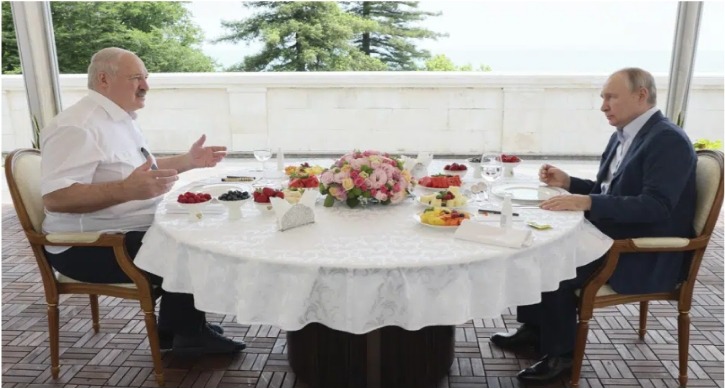
Russian President Vladimir Putin has made a significant announcement, revealing plans for the deployment of tactical nuclear weapons to Belarus in the near future. During a meeting with Belarusian President Alexander Lukashenko, Putin shared that the construction of necessary facilities for these weapons would be completed by July 7-8, following which they would be swiftly transported to Belarus. However, the Belarusian opposition has interpreted this move as an attempt to exert pressure on the West.
This development takes place against the backdrop of increased attacks by Ukraine in various sectors of the front line, leading some observers to believe that a long-anticipated counteroffensive is underway. It is worth noting that Russia previously utilized Belarusian territory to dispatch troops into Ukraine in February 2022 and has since maintained forces and weapons within its ally’s borders.
In a televised statement during a meeting with Lukashenko in Sochi, Putin confirmed the progress of the deployment and expressed that preparations for the facilities would be finalized in early July. Furthermore, he emphasized that Russia would retain control over the nuclear weapons once they are deployed in Belarus. Tactical nuclear weapons possess the capability to target enemy troops and weaponry on the battlefield, with a shorter range and lower yield compared to long-range strategic missiles capable of inflicting significant damage to entire cities.
While the precise number of nuclear weapons to be sent to Belarus remains undisclosed by Russia, the U.S. government estimates that Russia possesses around 2,000 tactical nuclear weapons. This includes bombs deployable by aircraft, warheads for short-range missiles, and artillery rounds.
The move by Russia has widely been interpreted as a signal to the West, especially as Western nations have increased their military support to Ukraine. Putin’s earlier announcement of the planned deployment was perceived as a warning to the West. By stationing tactical nuclear weapons in Belarus, Russia aims to assert its military capabilities and potentially deter further Western involvement in the region.
The deployment of tactical nuclear weapons to Belarus has sparked concerns regarding escalating tensions and the potential for further destabilization in Eastern Europe. It is anticipated that the international community, particularly countries involved in the Ukrainian conflict, will react to this development. Careful monitoring of the situation in the coming weeks is necessary, as it may carry significant implications for regional security and geopolitical dynamics.